Celestial Eightball

Celestial Eightball
When I was in high school, I dabbled in shooting pool. In the beginning, it seemed to be a game of luck — I might randomly hit a long shot but those gains came mostly by chance. As I began to understand the physics and geometry of the game, I liked it even more.
Even as I improved, repeatability was still the obstacle. It wasn’t the game at issue — given a level table with a clean, unworn felt surface and undamaged balls, any shot can be repeated over and over and over again. The hindrance to consistency was my eye-hand coordination. My tendency, however, was to blame the uneven table, or unbalanced balls, or warped cue stick. No way the fundamental problem could have been me.
Cosmology
Science is a lot like billiards. Consistency and repeatability provide us the means to learn from observation, but our egos and our assumptions often prevent us from recognizing the truth.
For most of my life, scientists contended that the universe was eternal and that, given enough time, any sequence of events could combine to get us to where we are today. After all, Albert Einstein asserted that concept for much of his career…until he didn’t. Einstein eventually labeled the cosmological constant (and by extension, the steady state) the greatest blunder of his career.
When Fred Hoyle coined the term, “The Big Bang”, in 1949, he was simply being a smartass and derisive on anyone who failed to share his naturalist worldview. Well, old Fred is gone and for the most part, so is his steady-state belief.
Today, Astronomers and Physicists overwhelmingly interpret the evidence to indicate that the universe had a specific beginning and has been expanding for the last fourteen billion ± years. Even more, everything in science points to order, intelligent design, and repeatability rather than randomness and chance.
“Earth’s Moon in the Corner Pocket.”
Roughly 4.5 billion years ago, another celestial body struck the Earth with a glancing blow something like a cut shot in pool. The resulting mass, which separated itself from the Earth and/or the cue ball, left us an extraordinary moon. As physics wore that moon into a prefect orb, it created one of the greatest scientific tools mankind has ever known.
The ratio of our moon’s size to the size of our Sun, is precisely the same as the ratio between the Earth/Moon distance and the Earth/Sun distance. Consequently, in a total solar eclipse, the moon perfectly covers the surface of the Sun, allowing astronomers to study the Sun’s corona with precision.
Moreover, the moon has no atmosphere to obscure or distort our view of the Sun’s corona. Perhaps that’s all just the result of a one-in-a-bazillion eightball shot but I’m skeptical.
Too many other things — like the moon’s gravity holding the Earth to a minor off-axis tilt instead of a large tilt that would result in fried humans — point to a fine-tuned universe. That’s not to say there’s no intelligent life elsewhere in the cosmos. It simply means that this planet and this segment of our universe were intentionally designed to defy astronomical odds in order to support you and me.
Heads: Pseudo-Science
Science only works if scientists are committed to the concept that truth is to be discovered rather than defined. The willingness to publish one’s work and let others tear it to shreds in order to see what survives, is the heart of the scientific method. It leaves no room for ego but plenty of room for collaborative discovery.
Even Einstein — arguably the smartest man of our age — yielded to the empirical evidence of his mistake. Yet, today, there’s a large contingency within the scientific community that serves the grant machine rather than evidence. Talking heads argue for conjecture and substitute popular approval for empirical proof…just so long as someone is willing to fund their experiments.
What does that say about our ability to move forward?
Tails: Pseudo-Spritituality
Spiritual knowledge and scientific knowledge are just two sides of the same coin, and both are susceptible to the same biases. If science addresses the “what”, spirituality addresses the “why’ and the two fields should complement each other. But much of what passes for spirituality today — whether it comes in the flavor of Islam, Buddhism, Western Christianity, Judaism, or any other ethic, is geared towards making the “believers” feel superior to all those “non-believers”.
We’ve come to the point of defining God based on our own egos instead of discovering the Creator of everything based on the evidence, some of which was discovered by those who went before us. What if the truth is right before our eyes but we are too inwardly focused to recognize it?
Bottom Line
I don’t believe in chance, and I don’t believe in blind faith, but I do believe there is good and rational evidence to lead us to the truth. The difficulty is that the evidence demands we give up thinking of ourselves as gods before we can interpret it clearly.
Think I’m crazy? Prove me wrong. I’ll even buy you coffee or something stronger so you can present an alternative solution. Maybe we could even discuss it over a game of eightball.

There is something fascinating about science. One gets such wholesale returns of conjecture out of such a trifling investment of fact.
― Mark Twain
 Let’s talk. I’d really like to hear what you have to say, and it might even give me something to write about. Email me at guy@lawsoncomm.com.
I’ll buy you coffee and we can compare notes. I promise not to steal your ideas without permission.

IS ATHEISM DEAD
— Eric Metaxas
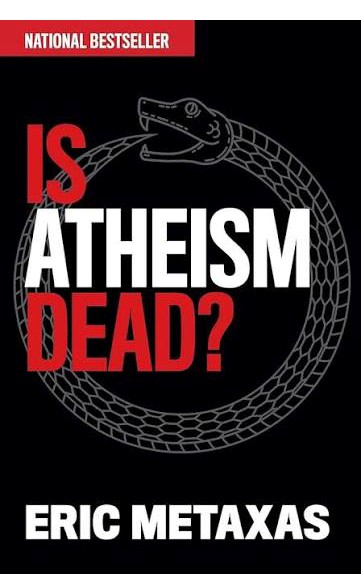
Perhaps no other author that I’ve read has produced such a succinct collection of research on the Fine Tuned Universe. Metaxas also bolsters his claims with phenomenal findings from Anthropology and recorded history. Whether you agree with him or not, his findings will cause you to seriously consider why you believe what you believe. You will also be scratching your head as to why the mainstream media has totally ignored these discoveries.
Did someone forward this newsletter to you after reading it themselves? Don’t settle for that!
CLICK HERE
to get a fresh, unused copy of this newsletter sent directly to you every Sunday morning. If you decide it stinks, you can always unsubscribe.
A meeting of great minds who think alike