The Enigma of Complex Simplicity

The Enigma of Complex Simplicity
Every time I peer into the night sky or ponder why a dead piece of lumber doesn’t just disintegrate into a trillion independent atoms, I’m reminded that nature is a complex hierarchy of physical laws — many of which elude our comprehension. The four forces of Physics which we currently understand — the strong and weak atomic forces, electromagnetism, and gravity all include a single overarching characteristic — attraction.
EVERYTHING, from atomic structure to humanity to the outer universe, is a series of complex systems designed to support one simple design principle: attraction between elements of every size and composition. It stands to reason that all Human existence is therefore about relationships.
Some of my relationships are created on a solid foundation and are beneficial while others, due to their misguided attraction, are detrimental. But relationships (even detrimental ones) dominate our existence.
Ask any divorced person with children from that earlier marriage and they’ll quickly verify that children are those outer-level electrons that orbit disparate atomic nuclei and assure a lasting covalent bond, regardless of the discomfort level that bond may entail. He/she ain’t ever goin away as long as those kids exist.
Familial Relationships
Like you, my first significant relationship was with my family. Mine proved to be a complex dance of siblings revolving around that parental nucleus. I showed up late to the game — my mother was already 36 years old, and my father was in his early forties. My three sisters were roughly a decade my elder and my nearest sibling, my brother, was older by three years.
As the first boy in the family and nearer in age to my sisters, my brother fit in, but I inhabited that outer ring of the atomic shell. Those sibling-electrons couldn’t get rid of me because of the nucleus so they tended to ignore me. Consequently, I’ve always harbored the self-image of an outsider and have been a bit reluctant to engage in trust.
Common Interest Relationships
My second memorable relationship was with Linda Ferguson, the red-headed girl next door. She was the same age as me but a year behind me in school. Ours was not a sexual relationship because neither of us yet possessed the hormones that would, in our teens, form that invisible magnetic attraction which teaches us all the meaning of anxiety.
In the years from pre-school until she moved away in fifth grade, Linda and I shared common interests — we both loved exploring and we both loved taunting our siblings. Linda had an older brother named Buddy who was my brother Bill’s same age. And, yep, she had an even older sister named Laura who doggedly ignored her.
One Saturday morning, I was experimenting with a large piece of Styrofoam (three feet by three feet by six inches) which my father had rescued from the dumpster at his job. Our unpaved alley had been wallowed out by automobile traffic so that it formed a swampy, two-foot deep, mud-lined pool after each big rain.
Like any inquisitive eight-year-old, I was testing the buoyancy of the Styrofoam and discovered it could hold my weight and float me across the miniature pond, though barely. That’s when Linda showed up in her lacy red dress and frilly petticoats and ruby slippers that could have come straight from Oz. I should insert here, that Linda’s family were Seventh Day Adventists and faithfully attended church every Saturday.
To make a long story short, Linda, dressed for church, did, at my behest, attempt to traverse the mud pond atop the Styrofoam. Something went wrong. She fell in, and the muddy aftermath caused her family to be late to church (very late).
That, in turn, resulted in a nasty call from Linda’s mother to mine and me being forbidden from offering other kids free rides on my Styrofoam raft. None-the-less, Linda rode it again that evening with similar results — though less elaborately adorned — culminating in the same mother-to-mother bitchfest. Had I not convinced my mom that riding atop the raft was Linda’s idea, and I in no way encouraged her to stand up while riding my raft, I might have received a whipping.
Apart from being amiably gullible, Linda was also what one might call “math-challenged”. Every summer, our older brothers would give in to boredom and invite Linda and I to join their Monopoly game. Linda had it in her head (possibly with some encouragement from me) that the height of her stack of bills was what was important. She would trade in all her larger bills until she had all the one-dollar bills in the game.
Everything would proceed calmly until Buddy would inform Linda that all her one-dollar bills combined were not enough to pay rent on Boardwalk. And just like clockwork, Linda would explode, overturn the Monopoly board, and storm out crying.
Then, as always, Linda’s mom would lecture us mean boys on the evils of mistreating girls. Enduring the lecture was worth the entertainment value of Linda’s act. It might take me weeks to re-convince Linda that her stack of one-dollar bills was not the issue but rather that her brother, Buddy was just evil and could eventually be beaten at Monopoly using “our” secret strategy.
Common Foe Relationships
My third set of relationships were the school comradery relationships which should be more accurately labeled “common foe” relationships. As a proud student at Beaver Elementary School, I joined my peers in looking down on those lesser kids who attended Bullock Elementary School only a few miles away.
Later, when Beaver and Bullock students co-mingled at Jackson Junior High, we had nothing but disdain for those kids over at Bussey Junior High, several miles away. But finally, when both junior highs converged at Garland High School, we enjoyed unanimous disgust towards the students from South Garland High School — even to the point of prematurely igniting their homecoming bonfire.
Common-foe relationships are by far the most tenuous of relationships, yet they seem to be the foundation of Middle Eastern culture. An old Arab proverb goes something like “Me against my brother. My brother and I against our cousin. My brother, my cousin, and I against the world.” No wonder Arabs and Jews are still warring over thousand-year-old grudges about Abraham’s dalliances.
The bottom line is that lasting and meaningful relationships may be complex, but they’re still based on the same simple rules of atomic attraction that drive the entire universe. And, like quarks and muons, they can impact us from thousands of miles away.
What If?
What if ALL the complexity of nature — even outside our planetary system — boils to RELATIONSHIPS at every level of existence?
What if the true definition of an object at rest is not “an object traveling in a straight
line at a constant speed” but rather one which has achieved equilibrium in its relationships.
What if understanding the simplicity amidst the complexity revolves around embracing relationships?
What if the definition of success in this dress rehearsal for life that we currently inhabit, is how well we foster and improve those relationships?
What if our entire culture, based on personal-autonomy and common foes, is fundamentally running afoul of basic universal principles?
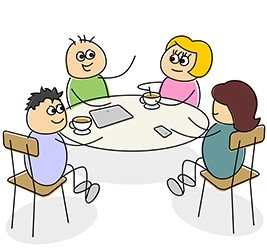 Let’s talk. I’d really like to hear what you have to say, and it might even give me something to write about. Email me at guy@lawsoncomm.com.
I’ll buy you coffee and we can compare notes. I promise not to steal your ideas without permission.

Ultimately the bond of all companionship, whether in marriage or in friendship, is conversation.
— Oscar Wilde

Did someone forward this newsletter to you after reading it themselves? Don’t settle for that!
CLICK HERE
to get a fresh, unused copy of this newsletter sent directly to you every Sunday morning. If you decide it stinks, you can always unsubscribe.

The Evidence for Modern Physics:
How We Know What We Know
— Professor Don Lincoln
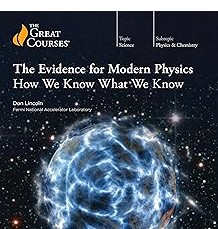
This Audible book won’t make you any smarter but it will definitely make you more entertained. The subtitle tells it all — When Math Goes Wrong. Listen to it while you’re waiting on those pokey gym tourists to get off your stationary bike.
A meeting of great minds who think alike