Who Killed Jesus
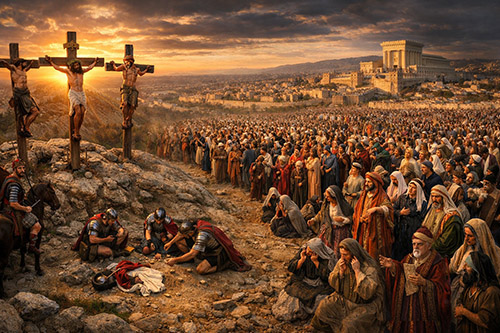
Who Killed Jesus?
Three Perspectives
Today is Easter Sunday and whether or not you and I agree on its significance, one out of every three people on the face of the Earth celebrate it. So, maybe it’s worth evaluating. This overview is not intended to pass judgement on any of the following views. Rather, it’s intended as a conversation starter.
Answer One: Nobody killed Jesus. The New Testament is a collection of myths created by the early Roman Catholic church to manipulate the populus.
That’s a view held by many. On the surface, it seems like a valid observation. However, from a historical perspective, it ignores extra-Biblical writings that document the extraordinary life and death of Jesus — even more documentation than that of Julius Caesar’s life. For more on that perspective, see “Evidence That Demands a Verdict” by Josh McDowell. (2017) Thomas Nelson. Incidentally, McDowell was an atheist when he first began researching this book in the early 1970’s.
Answer Two: Those nasty Jews convinced the Romans to carry out the deed.
This answer is true from a strictly historical perspective but its only viable if Jesus was merely a good teacher and lying about his claim to be the Author of the life. It fails to account for what sets him above hundreds of other good teachers throughout history, and why His story has outlasted so many critics.
Answer Three: He was who the Bible says he was — the Creator of everything in existence — and He died of his own volition.
Three common issues with this narrative:
If He was God, why didn’t he create a perfect world without suffering and pain?
What kind of God would kill his own son?
Why didn’t He just jump down off that cross and save himself with a giant “TADA” like the thief to his right admonished him?
What if
What if Jesus was, in fact, the Author of the Big Bang and He created a complex system capable of regenerating and evolving? And, what if there is even more to creation than we can comprehend with only our five senses?
What if our physical death in this life was never intended to be the end of the road but rather a bridge to the next step of our development? Yet, through the exercise of our free will, and our desire to be our own gods, we subverted the system and brought about chaos? What if the result of our arrogance is that creation itself — mirroring the human immune system when confronted by a rogue element — seeks to purge us and return to equilibrium prior to that next step in development?
What if the Author foresaw from the onset that such a cataclysm would occur and could only be averted by His intervention, yet he intentionally allowed mankind to exercise free will rather than become a herd of puppets.
What if He waited three million years for mankind to evolve to a point of common languages and written history so that two thousand years after His intervention, you and I would still have a record of Him saying, “I am the way, the truth, and the life. No-one comes to the Father but through Me”.
If that is the case, as the biblical narrative purports it to be, then you and I must admit that it is we, via our own arrogance, who helped bring about the crucifixion of the Author of the universe. The resurrection celebration of Easter is an annual reminder of who He is and how highly he regards us that He would make such a sacrifice on our behalf those who broke his creation.
When you’re helping the grandkids hunt for those hidden Easter eggs this year, don’t forget that there’s also more Truth still hidden in plain site than we have discovered in all of history. Let me know if you come across any of it. I’d love to hear your thoughts.
 Let’s talk. I’d really like to hear what you have to say, and it might even give me something to write about. Email me at guy@lawsoncomm.com.
I’ll buy you coffee and we can compare notes. I promise not to steal your ideas without permission.

Look at the cross and you will know what one soul means to Jesus.
— Mother Teresa

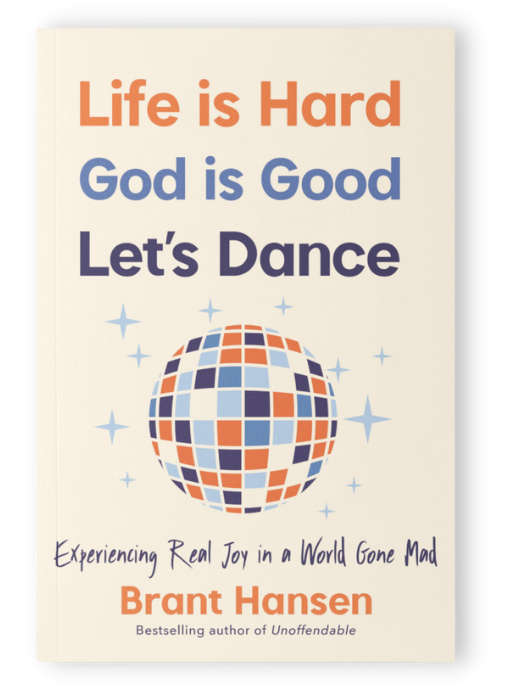
Life is Hard, God is Good, Let’s Dance
— Brant Hansen
Hansen is just kooky enough that he makes perfect sense. He has truly discovered that you don’t have to dislike people just because they think differently than you, even if they refuse to like you because of the way you think. If you like this book, he has several more that are equally engaging.

Did someone forward this newsletter to you after reading it themselves? Don’t settle for that!
CLICK HERE
to get a fresh, unused copy of this newsletter sent directly to you every Sunday morning. If you decide it stinks, you can always unsubscribe.
A meeting of great minds who think alike