Astronomy 101
Astronomy 101
It took me five years to graduate from the University of Texas, not because I was lazy (though that may have played a role), but because I held down two part-time jobs along with my studies, in order to support myself. Those were the days before the opiate of government guaranteed student loans.
At the onset of my final year, I spent time with one of the counselors to make sure I’d have all the required credits to graduate. Surprisingly, since I’d focused my limited time on core courses, I discovered that I still had nine hours of lower division electives that I could use.
Lower division courses were not really intended to pass on significant information, but rather to ease incoming students into the academic setting. In general, one could easily pass a lower division course by either reading the textbook or attending all the lectures where that same textbook content was rehashed.
As one of my “gimme” credits, I chose to take Astronomy 101. It happened that my older brother was back in our hometown running a planetarium for the school district, so a simple phone call to him would handle any questions that I couldn’t figure out for myself.
On the first day of class, a serious looking professor explained to the auditorium of 300 students that our entire grade would consist of only a mid-term exam and a final exam. That elicited a wave of moans and even a few quick exits by the more intimidated students. She went on however, to explain that there would be five “viewings” that could be voluntarily attended. Each recorded viewing attendance would add ten (yep, ten) points to the student’s final grade.
Anyone who faithfully attended the viewings, would have fifty bonus points before ever taking an exam. Apparently, those early exiters were also mathmaticly challenged. I attended the twice-weekly class a total of three times that semester — that opening intro lecture, the mid-term, and the final exam. Once I realized how remedial the material was, I only wasted time attending a single viewing, mostly out of curiosity.
Academic Boondoggle
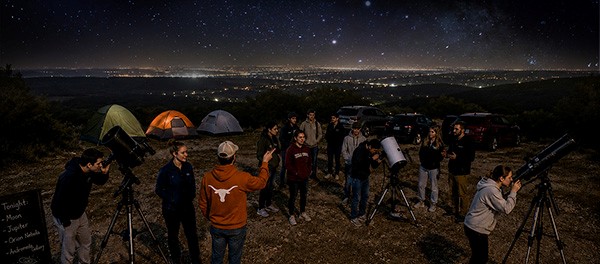
The viewings were set up and managed by graduate students working as Teaching Assistants. They consisted of a dozen or so students meeting at the campus and carpooling in a caravan to a viewing site some thirty miles outside of Austin. As you might expect, it doesn’t take long to peer through a pre-aligned telescope, express sufficient awe, and sign your name to the attendance log. That left the remainder of the cold, dark evening to enjoy the ice chests of cold beer and recreational herbs that had magically appeared.
My suspicion was that the viewings were a scam devised by the grad students in order to amass credits while ingratiating themselves to the naïve freshman co-eds who attended the events. Not surprisingly, there were two or three camping tents available for those who felt too buzzed to drive back into Austin that night, although I’m betting a shortage of sleeping bags necessitated sharing.
Light Pollution
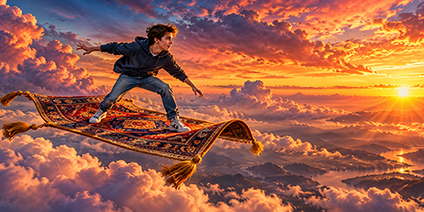
In those days, Austin was a much smaller town than it is today, but we still had to drive a good way out of town to escape the light pollution that permeated the night sky and hindered star gazing. I once discussed the light pollution topic with my brother, thinking that it might pop up on an exam. He explained that virtually all working observatories are either on mountain tops or at least far removed from urban areas.
There are good and bad aspects to that situation. On the one hand, observatories tend to be quiet places suitable for serious contemplation and study. On the other hand, they tend to be so remote that medical help, if needed, is far away and unattainable.
I have an old friend who spent much time working at an observatory on the North Texas plains. If you know much about rural North Texas, you know it’s teeming with Diamondback Rattlesnakes. My friend managed to avoid the snakes but he did suffer a stroke that went untreated for two or three days until someone came to check on him. Years later, he’s still recovering from that experience.
Brain Smog
Apart from the inherent risk, the upside of spending all that time alone in a remote location is the absolute silence. I read a book on mindfulness a few years back, in which the author recommended that every human being spend at least a few days each year in remote solitude, just listening to our brains and learning who we really are.
We are so over stimulated by the urban pollution of social media, television, politics, and rush-hour drivers, that we’ve likely forgotten who we are and what we once intended to do with our lives. Perhaps it’s time we bought ourselves some telescopes and single-malt scotch and started having our own viewing parties every few weeks. Let me know if you’d like to carpool.
 Let’s talk. I’d really like to hear what you have to say, and it might even give me something to write about. Email me at guy@lawsoncomm.com.
I’ll buy you coffee and we can compare notes. I promise not to steal your ideas without permission.

Live each day as if it were your last, without frenzy, without apathy, without pretense.”
― Marcus Aurelius

Did someone forward this newsletter to you after reading it themselves? Don’t settle for that!
CLICK HERE
to get a fresh, unused copy of this newsletter sent directly to you every Sunday morning. If you decide it stinks, you can always unsubscribe.

Understanding Mindfulness
— Ronald D. Siegel
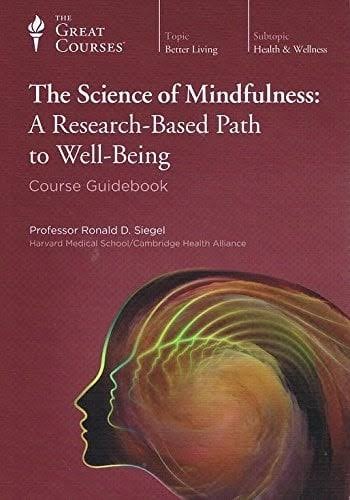
It’s been a while since I read this book but this week’s story reminded me how much practical information it contains. Siegel communicates the science behind mindfulness as well as the benefits. Even more, he provides multiple practical applications that anyone can employ.
A meeting of great minds who think alike