Speed Limits
Speed Limits
Do ants understand the speed limit? Whether you laughed at the stupidity of that question or began to doubt my sobriety for asking it, you have to admit that you didn’t take it seriously. Perhaps you should have.
As residents of the food-chain-penthouse, we naturally assume that everything beneath us is less intelligent because its lower on the evolutionary scale than we are. But is it less intelligent? Or is it simply different?
In the Summer of ’75, I was home from college and spent three months working as a draftsman for a local electronics manufacturer. A likable guy named Ken sat at the drafting table next to mine. He was ten years my elder and married. More important, he spoke very broken English. Ken was one of the original Vietnamese boat people, having escaped after the fall of Saigon.
Ken, his brother, and both of their wives fled their homeland after the communists killed their parents. They landed in the Philippines, eventually made it to Los Angeles, and somehow found their way to Dallas. Yet, they still had a huge cultural and language barrier to overcome.
Ken and the Speed Limit
On July fourth, a three-day weekend, Ken’s tight-knit little group decided to visit the world-famous Las Vegas. They were too poor to fly so they decided to drive the twelve-hundred-mile trip, across the desert, at might, in Ken’s aging Opel Kadett. (Apparently, when you’ve survived a Communist takeover of your country, the execution of friends and family, and narrow escape across the South China Sea in a leaky fishing boat, you tend to have a different concept of risk than a college kid living with his parents.)
While I looked on, shaking my head, Ken and company left work at 5:00PM on Friday evening. They drove through the night, arriving in Vegas early enough to enjoy the lunch buffet on Saturday. It was on the trip home that Ken learned the significance of speed limits.
In the desert, there are generally no speed limits, but traveling through small towns along the way forces drivers to slow way down. When a motorcycle cop stopped Ken and asked incredulously if he knew how fast he’d been driving, Ken answered honestly in his broken English that, “No. The speedometer not go past 100.” Fortunately, the cop was a Vietnam vet and after ascertaining Ken’s past and their mutual hatred of Communists, the cop simply warned Ken that he needed to slow down to 50 in small towns.
All Summer long, events like that one, combined with Ken’s inadequate grasp of English, along with his low-wage job, led me to believe he was not all that bright. It wasn’t until my last week on the job that I learned Ken held a master’s degree in electrical engineering from the University of Hanoi. He was incredibly astute but culturally challenged. I had simply jumped to the wrong conclusions.
Einstein and the Speed Limit
In the early twentieth century, Albert Einstein posited that light was the fastest moving thing in the cosmos and that the speed of light was the speed limit of the universe. That theory stood unquestioned for nearly a century. In recent years, especially since the rise of quantum physics, scientists have begun to question Einstein’s model.
In all likelihood, research into Quarks, Muons, and Neutrinos will yield a modified view of that speed limit — not because Einstein was stupid but because he lacked the benefit of discoveries we now take for granted. Modern scientific methodology and tools are rapidly widening our understanding of everything from the immense universe, down to the tiniest of elements.
The Middle Ground
In between those two extremes of physical hierarchy are things more common to us, like viruses, bacteria, and even animal life. We’re just beginning to learn about intelligence within these entities. Herpes viruses are intelligent enough to infiltrate the human body and disguise themselves as a means of evading the human immune system for years. Bacteria actually construct multi-element tools to help them move about.
What if we come to understand that all of nature is living on a similar intellectual plane to ours but that we just can’t understand those disparate elements because they’re living and communicating at different speed limits than we are. Whereas we live an average of eighty years some bacteria only live for hours while the lifespan of a granite mountain can be millions of years.
Is it possible that we’ve completely ignored the fact that an intelligent creator might have chosen to endow more than Humans with superior cognition — a fact that we’ve completely missed because we’re moving too fast to relate to our surroundings?
You’ve got to wonder how our ethics will be impacted if/when we discover those animals we’ve been eating were self-aware. But before you jump on your judgmental vegan bandwagon and condemn all of us carnivores, you might want to read up on Fungi and consider that the tasty mushroom you just popped into your mouth, most likely knew its grandparents.
Perhaps we just need to slow down and realize that there may be more to life in this closed system than we’ve led ourselves to believe.
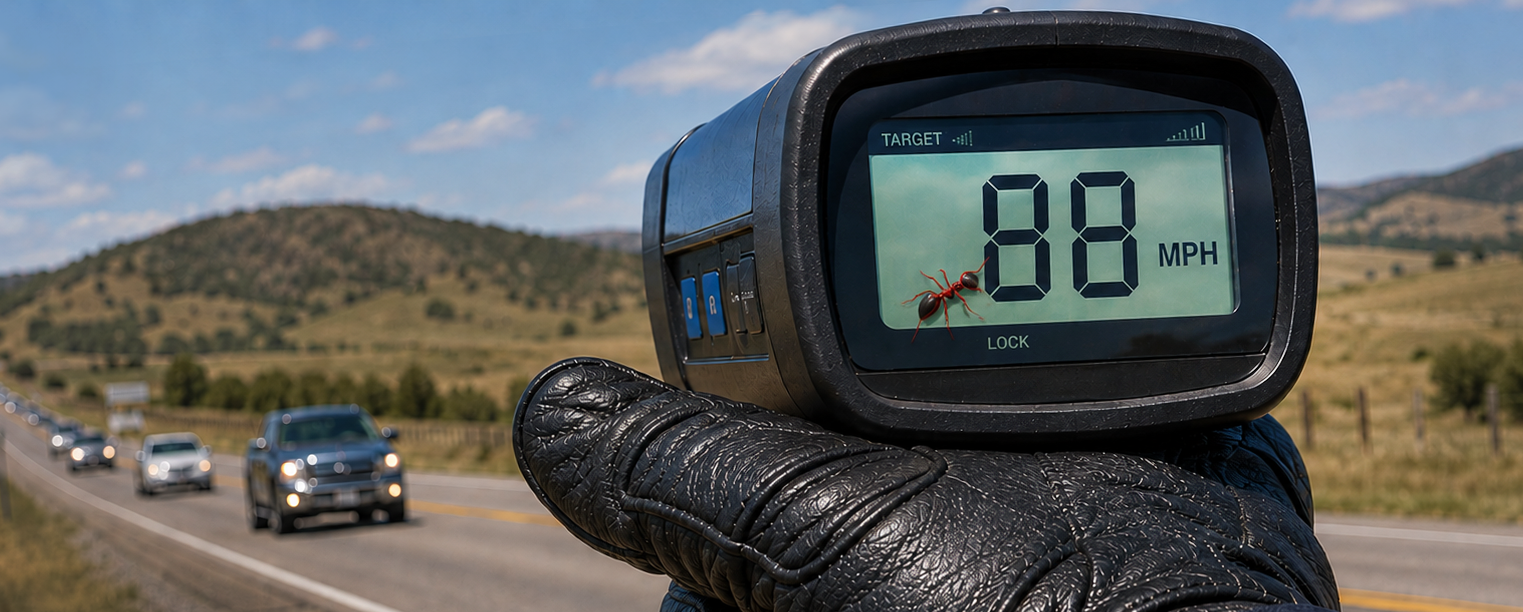
Maybe there’s even an ant on the back of a radar gun somewhere pondering why stupid humans can’t cooperate with each other or obey their own speed limits.
 Let’s talk. I’d really like to hear what you have to say, and it might even give me something to write about. Email me at guy@lawsoncomm.com.
I’ll buy you coffee and we can compare notes. I promise not to steal your ideas without permission.

Discovery is seeing what everyone else saw and thinking what no one else thought.
— Albert Szent-Györgyi
But ask the animals, and they will teach you, or the birds in the sky, and they will tell you; or speak to the earth, and it will teach you, or let the fish in the sea inform you.
— Job 12:7-8

Did someone forward this newsletter to you after reading it themselves? Don’t settle for that!
CLICK HERE
to get a fresh, unused copy of this newsletter sent directly to you every Sunday morning. If you decide it stinks, you can always unsubscribe.

I Contain Multitudes:
The Microbes Within Us and a Grander View of Life
— Ed Yong
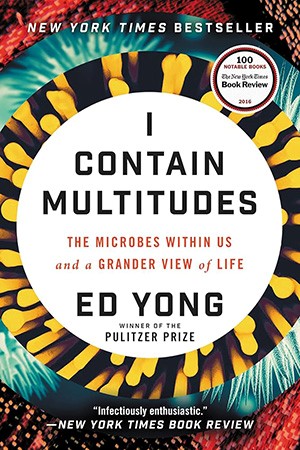
Yong explains how humans, animals, and plants are not independent organisms but ecosystems filled with trillions of microbes — bacteria, fungi, viruses, and other microscopic life forms. These microbes live inside and around us, shaping our digestion, immune systems, behavior, development, and even evolution.
Entangled Life
— Merlin Sheldrake
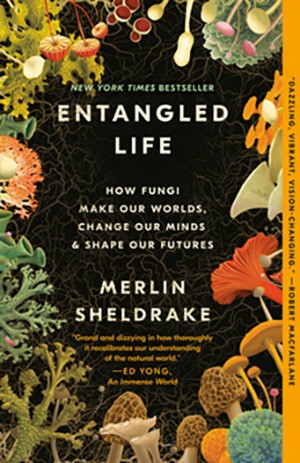
Sheldrake argues that fungi are foundational forces that shape ecosystems, evolution, human culture, and even consciousness. He combines biology, ecology, philosophy, and history to challenge traditional ideas of individuality and intelligence, contending that life is fundamentally interconnected, with fungi acting as mediators between organisms and environments.
A meeting of great minds who think alike