Black Clay and Swamp Coolers
Black Clay and Swamp Coolers
At one point during my five-year incarceration at the University of Texas, I was taking an engineering class in an old East-campus building where the Geology courses were taught.
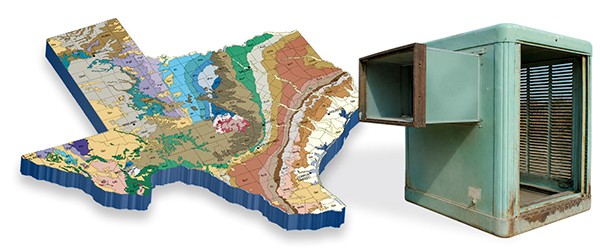
While killing time after class one morning and deciding whether to hike across campus to my next class or make the shorter trek to the student union for breakfast, I was studying a giant wall map of Texas. It showed all the different geological zones of our great state.
An older, gray-haired gentleman sidled up next to me and said, “Interesting stuff isn’t it?” Then, he asked if I was a Geology major. I confessed to being a lowly Mechanical Engineering Freshman but added that I did find the map interesting. When I asked what the green swath was that ran from below Waco, through Dallas, and all the way to the Red River, he replied, “It’s the worst patch of soil on God’s green Earth.”
He went on to explain that it was a strip of black clay, not particularly rich in nutrients and unusually difficult to build on because of its tendency to move en masse with weather changes. Anyone who’s ever owned North Texas property that’s more than twenty years old, knows the truth of that observation, backed up by the proliferation and transient nature of foundation repair companies in our area. “Lifetime Guarantee” my ass!
About the only crops that can survive in that nasty black clay, are Maize and Cotton. As it happens, when I was a kid, my little neighborhood backed up to several hundred acres of farmland that alternated between those two crops. More important, that field provided an excellent recreation area featuring the best mud-clod producing black clay soil on God’s Green Earth.
Kids from all over my neighborhood gathered in that field and squared off for frequent mud-clod fights. Although the dense green Maize grew high enough to provide inter-row furrows, we could traverse on our bellies without being spotted by the enemy, cotton was not so useful.
Necessity Prevails
While necessity is the mother if invention, it is not always the mother of good invention. In those pre-air-conditioning days, our homes survived the North Texas Summers by using Swamp Coolers — massive outdoor evaporative coolers with a squirrel-cage fan mounted above an open tank of continuously evaporating water. Those fans blew the slightly cooler air into our homes via a window mount. You could call them the precursors to window-unit air conditioners.
Why nobody ever predicted that bodies of stagnant outdoor water would attract Godzilla-like mosquitos or become petri dishes for massive quantities of black mold, is beyond me. Fortunately, in 1963, my family moved five houses down the street to a home with — drumroll please — central heating and air conditioning.
My dad, being the consummate salvager, took the swamp cooler with us and gutted it to use the powerful fan in his garage. That left the massive green carcass of the swamp cooler body available for use by anybody with imagination.
If necessity is the mother of invention, imagination is the mother of re-invention. What my dad saw as a rusting pile of sheet metal, my older brother and I saw as a mud-clod-launching super-fortress. We quickly mounted a couple of used bicycle innertubes in the large air vent tunnel and connected them to an old funnel on the other end.
Once dragged into the cotton field, two guys could hide behind the cooler, making dense, tightly packed mud-clods in the safety of their shelter. Meanwhile, soldier number three sat protected inside the cooler body, catapulting those tightly packed mud-clods with deadly accuracy and extended range.
The swamp cooler/fortress was a colossal success in mechanical engineering … until the Sunday afternoon when I nailed a kid between the eyes, flipping him over backwards. By the time we called a cease-fire and reached him, a giant golf ball-sized hematoma had sprouted from his forehead.
There were plenty of reasons for the accident — I was only firing a warning shot and didn’t expect him to look up when he did. The mud-clod my brother handed me was too heavy and I misjudged the drop over that range. The clod that hit him actually fell from the muddy tire of a passing crop duster. (I chose door number three.)
But once the musical chair game of blame-passing came to a stop, I was the guy still standing and had to transport the unfortunate casualty home on my bicycle. His mom turned white, and then red, demanding to know who threw the murderous clod at her son. In her rush to get him in the car and haul him to the doctor, I felt like she possibly believed my story that the clod literally fell from the sky.
None-the-less, my dad dismantled our engineering masterpiece and took the parts to a scrap metal yard. I think the unlucky kid eventually recovered but he never joined in any more of our mud-clod wars. I’m not even sure what his name was but if he sounds like someone you know, it really could have been falling aeronautical debris that caused his injuries.

Members of the community share not just a commitment to the idea of objective reality but also an understanding that outside of that commitment lies anarchy, a zone of chaos where reality splinters and truth loses its grip.
― Jonathan Rauch
 Let’s talk. I’d really like to hear what you have to say, and it might even give me something to write about. Email me at guy@lawsoncomm.com.
I’ll buy you coffee and we can compare notes. I promise not to steal your ideas without permission.

The Constitution of Knowledge:
A Defense of Truth
— Jonathan Rauch

Rauch argues that modern society is facing not merely a political crisis but a crisis over how we determine what is true. Rather than asking “Who is right?” he asks a deeper question: “How do we reliably separate truth from falsehood?” It’s a 12-hour read but it’s filled with thought provoking content.

Did someone forward this newsletter to you after reading it themselves? Don’t settle for that!
CLICK HERE
to get a fresh, unused copy of this newsletter sent directly to you every Sunday morning. If you decide it stinks, you can always unsubscribe.
A meeting of great minds who think alike