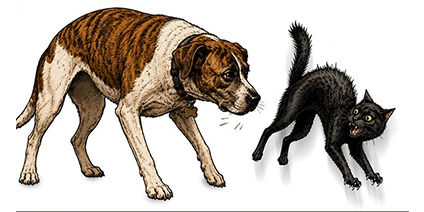
And

I listened to a really good speaker last week as he discussed a non-fiction story. It was a piece of literature I’ve read and even studied in-depth many times. The humbling thing was that this speaker started off with an aspect of the tale which I had never even noticed — the story began with “And”.
The speaker went on to relate the precursor to the “And” by providing additional historical text about the main character, a man who had at one time, been a nationally known celebrity, extolling the prosperity and success of his tiny country. But in the better-known part of the story — the part that followed the “And” — he became a self-serving neo-villain.
If you’re having a hard time picturing that, just imagine any person who went into politics with an honest desire to serve their community and subsequently evolved into, well, a politician. But this story is not about that story, nor is it even about politicians; This story is about the “And” that every story should properly begin with.
You and I are living in incredibly exciting times. These are the very days that future historians will look back on and either label as the onset of the new Renaissance or the onset of the modern Dark Ages. Science and technology are building on past findings at a speed that’s nearly impossible to keep up with. Meanwhile, the social fabric, not just in North America, but throughout the planet, is approaching a point of self-immolation.
It’s easy to blame strife on those charlatans on the other side of the political aisle, or the heretics who practice a religion other than our own, or the reprobates who fail to agree with our moral tenets, but the real problem is that all of us — you, me, the people we admire, and the people we scorn — are all ignoring the “And”.
An Epic Memoir
Everything we know is built upon previous chapters of our story, but it’s easy to forget that the saga we’re a part of is enormous. If you define the story of man as only “recorded history”, the story is roughly 5,500 years old, out of which you and I contribute to a chapter with a length of only 80± years.
But if we look back before the “And” that precedes recorded history, the development of our little blue orb alone took 4.5± billion years, the latest 3 million of which were devoted to the evolution of us. And, that story of the Earth is only one subsection of the 14.7± billion-year story of our universe. It’s a big book.
More important, every single advancement — the development of the cosmos… Earth’s closed system…man’s evolution…mankind’s growing knowledgebase — has been built on advancements that occurred in earlier chapters of the story. We look back a few chapters and wonder how our recent ancestors were so near-sighted, but we forget that everything we know is built on what we learned from their successes, “And” their mistakes.
And That’s Not All.
If the universe was indeed created via intelligent design, then there’s also a prelude, because design is always preceded by planning. The incredible truth is that the closed system we inhabit, was “pre-planned” not to merely be self-sustaining but to continuously replicate and adapt just like the human body.
Perhaps it was even designed to evolve into a collaborative unit where all the individual elements contribute unique attributes to the final masterpiece. But anything that complex and self-determining always incorporates the power to fail, especially if it does not learn from, and move past, the pre-“And” failures of its predecessors.
The only question is whether our tiny chapter in the story of mankind will be one of learning from past conflicts and flourishing through cooperation. Or will it be a chapter that strays from the main theme and initiates a massive culling of the herd? All good stories include a set-back in the middle of the plot. Perhaps that’s us.
Will our chapter of the big story start with “And” or “But”? The great enigma is that we, the characters, have been given the power to write our own outcome in this epic story.

If I have seen further, it is by standing on the shoulders of Giants.
― Isaac Newton, 1675
The Original Quote which Newton borrowed from:
We are like dwarfs perched on the shoulders of giants, and thus we are able to see more and farther than they, not because of any sharpness of sight on our part, or any physical distinction, but because we are carried high and raised up by their giant size.
— Bernard of Chartres (12th century philosopher)
 Let’s talk. I’d really like to hear what you have to say, and it might even give me something to write about. Email me at guy@lawsoncomm.com.
I’ll buy you coffee and we can compare notes. I promise not to steal your ideas without permission.

The Knowledge Machine
— Michael Strevens
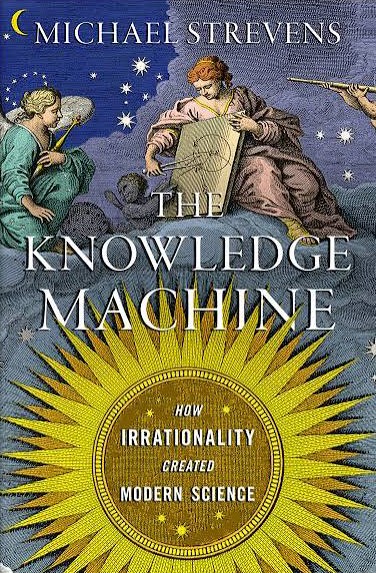
Strevens documents how science accumulates objective knowledge by eliminating ego-based biases of scientists through the use of publicly tested evidence. He goes on to talk about how genuine knowledge is built via centuries of discoveries, many of which are refinements of earlier discoveries. Most important, he demonstrates an understanding that absolute truth is always discovered and never defined.
For Russell: 8 hrs and 16 min.

Did someone forward this newsletter to you after reading it themselves? Don’t settle for that!
CLICK HERE
to get a fresh, unused copy of this newsletter sent directly to you every Sunday morning. If you decide it stinks, you can always unsubscribe.
A meeting of great minds who think alike