The Finger of God
The Finger of God
One of my most vivid memories of childhood was a day when I was five years old and playing alone in our front yard. Yep, in those days, young kids played in their own yards without a chaperone, and nothing happened to us. The world wasn’t safer; it was just less paranoid.
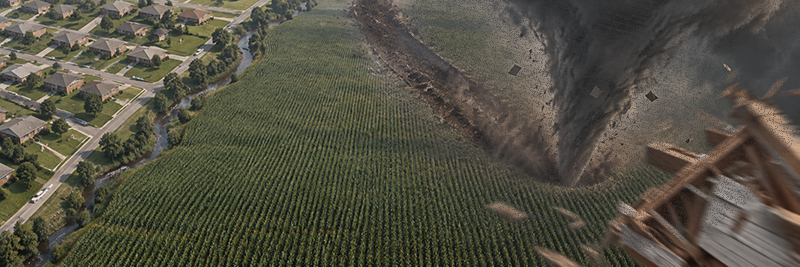
My little neighborhood was on the outskirts of a small North Texas suburb, and we were bounded along the north by a giant agricultural landscape which sometimes featured maize and sometimes sprouted cotton but always provided a superb setting for mud clod wars. On that particular Spring afternoon, I became mesmerized by the dark green and black clouds amassing out over the maize field at the end of my street.
At some point, what looked like a giant charcoal colored finger began to emerge from the whirling mass and extended all the way down to the ground, weaving and twisting as it lowered. It was enhanced by a giant vee of dirt which it dislodged and threw into the air like leaving the lid off a blender.
It was at that point that I felt my mother walk up next to me and lay her hand on my shoulder. I’d been so entranced by the scene that I never heard her come outside. We stood there for probably less than ten minutes observing the phenomenon, but it was one of the more spectacular things I’ve ever witnessed. Stuff was flying through the air and being lifted as if by magic to the base of the cloud cover high above.
It’s entirely possible my mother was remaining calm to keep me from panicking, but I believe she was equally frozen in place by what we were seeing — that was, until my dad came flying into our driveway in the family station wagon. He’d seen the same scene from where he worked a couple miles away and immediately rushed home to check on us.
Even though he was screaming for us to get inside, it took a few minutes for his words to soak into my mom as we stood defiantly watching the show. When we finally hurried inside, my dad informed us that all the debris in the air was large pieces of roofs and building material that could have easily fallen on us.
My dad was not normally a panicky person but, in his defense, he’d only a few years prior, had a front-row seat to a devastating tornado that tore through Dallas. Following that incident, he was forever fearful of tornados — not a good mindset if you live in North Texas.
When I consider the power of that tornado as well as the power of other natural disasters like earthquakes, tidal waves, volcanos, and hurricanes, I’m amazed at the nonchalance with which nature wipes out thousands of living creatures in a single stroke. That doesn’t even take into account the calamities mankind has unwittingly unleashed like nuclear radiation, man-made viruses, and devastating epigenetic side effects of our technologies.
This planetary closed system in which we exist is unquestionably driven by some level of intelligence that maintains its equilibrium. Does it have a consciousness? Does it wake up each morning and think, “Today, I need to eliminate 1,758,693 humans, three million animals, and 480,000 tons of plant life to make room for new stuff coming down the line”? Does it weigh that destructiveness against the consequences of maintaining the status-quo?
Are you and I the only creatures with a moral code? Why?
While you’re pondering that, don’t forget to keep an eye out for falling debris. And if you figure out the answers, send me a copy of your notes.


A superintellect has monkeyed with physics.
— Fred Hoyle,
Astronomer, Author, Atheist
 Let’s talk. I’d really like to hear what you have to say, and it might even give me something to write about. Email me at guy@lawsoncomm.com.
I’ll buy you coffee and we can compare notes. I promise not to steal your ideas without permission.

The Anthropic Principle
A Universe Built for Man
— Anthony Walsh
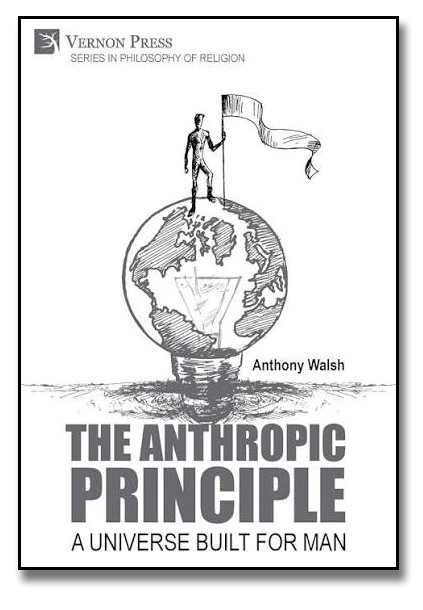
Walsh argues that our universe isn’t merely compatible with life but that it exhibits evidence of design and purpose specifically for the nurture of humanity. In case you’ve ever wondered about the difference between the Copernican (random chance) and Anthropic (purpose) principles, this piece provides a great comparison and explanation of each. It’s a book about the compatibility of science and theology.

Did someone forward this newsletter to you after reading it themselves? Don’t settle for that!
CLICK HERE
to get a fresh, unused copy of this newsletter sent directly to you every Sunday morning. If you decide it stinks, you can always unsubscribe.
A meeting of great minds who think alike